[:pt]Silencioso entendimento[:en]Silent understanding[:]
[:pt]
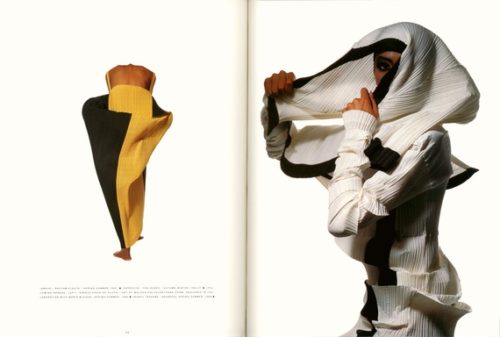
Issey Miyake by Irving Penn
O americano Irving Penn foi o um dos grandes responsáveis pela construção da imagem da mulher ocidental da segunda metade do século XX. Tendo ingressado na Vogue ao final da década de 40 pelas mãos de Alexander Liberman (com a função de ‘dar ideias para as capas’), acabou por se firmar como talentoso criador de imagens de moda, repletas do glamour e da sensualidade aos quais aspirava a sociedade americana do pós-guerra.
Se por um lado seu olhar quase aristocrático privilegiava poses de rígido formalismo – que remetiam às fotografias das décadas anteriores –, por outro lado o minimalismo e o despojamento percebidos nas imagens que criava sem dúvida mostravam o caráter inovador de seu trabalho. Mesmo quando a própria moda era construída por excessos, pelo olhar sensível de Penn filtrava-se o supérfluo, e o resultado eram sempre imagens de grande elegância e sofisticada simplicidade.
Nascido em Hiroshima 7 anos antes de a cidade ser destruída pela guerra, Issey Miyake é sem dúvida um dos mais geniais designers contemporâneos. Muito além do rótulo de ‘designer japonês’ que a imprensa internacional lhe costuma atribuir, Miyake jamais restringiu-se à identidade nacional, buscando sempre o equilíbrio entre tradição e inovação para criar projetos universais. ‘Eu crio não para expressar meu ego ou personalidade, mas para tentar trazer respostas àqueles que estão se perguntando sobre nossa era e como deveríamos viver nela.’
Partindo de um conceito simples e minimalista – ‘fazer roupa a partir de um pedaço de pano’ – o trabalho de Miyake resulta do antigo princípio de envolver uma figura tridimensional com material bidimensional utilizando-se de dobras. Aliando tecidos japoneses a cortes ocidentais, a novas tecnologias e ao conceito de funcionalidade, seu less is more constrói arquitetonicamente formas simples, elegantes e de rara beleza.
Ao longo de mais de 20 anos, entre 1975 e 1998, Irving Penn retratou o trabalho de Issey Miyake. A união entre esses dois artistas de origens culturais tão diferentes foi registrada em 1999 no belíssimo livro ‘Irving Penn regards the works of Issey Miyake’, de Midori Kitamura e Mark Holborn, e que depois gerou uma exposição na 21-21 Design Sight em Tóquio, Japão.
Esse encontro, que a princípio pareceria insólito, produziu centenas de imagens arrebatadoras, na medida em que o trabalho de um acabou se tornando espelho para o trabalho do outro. Sob o olhar de Penn, as poses das modelos fizeram das roupas de Miyake verdadeiras esculturas, em cenas que mais se parecem com fragmentos de uma dança; Miyake, por sua vez, ofereceu a Penn a chance de exercitar seu rigor formal com texturas, formas e máscaras vindas de outra cultura. E da união desses dois ‘mestres da redução’, como os definiu Holborn na introdução do livro, surgiram imagens secas, exatas e cortantes, que não oferecem espaço para nada além do essencial.
O resultado dessa bela parceria, a que Miyake poeticamente chamou de ‘silencioso entendimento’, comprova que os conceitos de beleza e elegância podem, sim, ser universais – e podem delicadamente tocar as mais diferentes almas por toda a eternidade.
[:en]
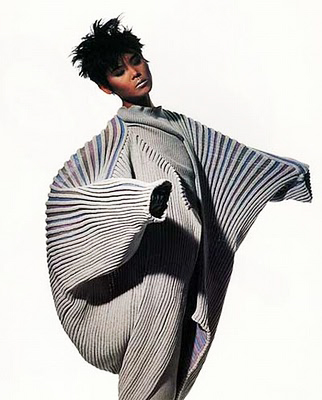
Issey Miyake by Irving Penn :: 1990
The American Irving Penn was one of the key people in building the image of Western women in the second half of the twentieth century. He joined Vogue in the late 1940s through Alexander Liberman (his job was to “come up with ideas for the covers”), and eventually established himself as a talented creator of fashion images, full of glamour and sensuality to which the post-war American society aspired.
While on the one hand his near aristocratic view privileged poses of rigid formalism – which made reference to photos of previous decades – on the other hand the minimalism and the plainness perceived in his images showed, undoubtedly, the innovative nature of his work. Even when fashion itself was built on excesses, the sensitive eye of Penn filtered out the superfluous, and the resulting images were always of great elegance and sophisticated simplicity.
Born in Hiroshima seven years before the city was destroyed by war, Issey Miyake is undoubtedly one of the most creative clothing designers of the last century. Far beyond the “Japanese designer” label usually assigned by the international press, Miyake was never restricted to national identity, and always sought balance between tradition and innovation to create universal designs. “I do not create to express my ego or personality, but rather to get answers to those who are wondering about our era and how we should live it.”
From a simple and minimalist concept – “making clothes from a piece of cloth” – Miyake’s work is a result from the old principle of mixing a three-dimensional figure with two-dimensional material by means of folding. By combining Japanese fabric with western patterns, new technology and functionality, his “less is more” concept builds forms which are architecturally simple, elegant and of exquisite beauty.
For over 20 years, between 1975 and 1998, Irving Penn portrayed Issey Miyake’s work. The merger of these two artists from such diverse cultural backgrounds was registered in 1999 in the wonderful book “Irving Penn regards the works of Issey Miyake”, by Midori Kitamura and Mark Holborn, which will be the subject of an exhibition at 21-21 Design Sight in Tokyo, Japan, starting in September.
This union, which at first seemed unusual, has produced hundreds of stunning images, in that their work turned out to be a mirror to each other’s work. Under Penn’s influence, the models’ poses turned Miyake’s clothes into true sculptures, portraying scenes that look more like fragments of dance moves; Miyake, in turn, gave Penn a chance to exercise his formal rigor with textures, shapes and masks from another culture. And the union of these two “masters of reduction,” as defined by Holborn in the foreword of the book, yielded images of a dry, sharp and accurate nature, which offer no room for anything beyond the essentials. The result of this beautiful partnership, which Miyake poetically called “silent understanding”, proves that the concepts of beauty and elegance can indeed be universal – and can gently touch the most unique souls throughout eternity.
[:]