[:pt]A chave[:en]The key[:]
[:pt]
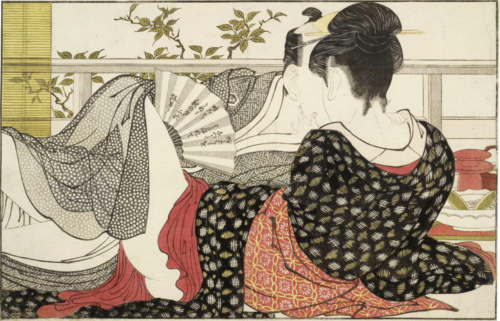
Kitagawa Utamaro :: Lovers in an upstairs room :: 1788 :: ©The Trustees of the British Museum
‘27 de fevereiro Como eu imaginava. Minha esposa mantém um diário. Até hoje tomei a precaução de não escrever isso neste caderno, mas na verdade minha atenção foi vagamente despertada alguns dias atrás. … Não sou tão vil a ponto de ler o diário de minha própria esposa sem sua permissão. No entanto, embuído de maus sentimentos, tentei retirar com destreza a fita adesiva que o lacrava, de forma a não deixar marcas. Queria assim demonstrar a minha mulher que uma fita apenas seria inútil.
…
7 de março …Foi então que encontrei a chave caída no mesmo lugar. Pensei que devia haver alguma razão e, abrindo a gaveta, retirei o diário do meu esposo. Para minha surpresa, estava selado com uma fita adesiva da mesma forma como eu tinha feito. Meu marido quererá por certo dizer-me “Experimente abri-lo”? … Estava curiosa para tentar puxar a fita sem deixar marcas. E foi por pura curiosidade que tentei fazê-lo.’
Jun’Ichiro Tanizaki é um dos mais respeitados nomes da literatura japonesa. Até sua morte (em 1965, aos setenta e nove anos), Tanizaki nunca tinha viajado ao Ocidente; e muito embora em sua juventude tivesse flertado com a modernidade ocidental, jamais foi influenciado pelos valores ou pela moral cristã.
Essas escolhas foram determinantes na estruturação de seu universo ficcional. Integrante da Tanbiha, escola literária que buscava a valorização da arte e da beleza (em contraposição ao naturalismo e ao objetivismo predominantes à época), Tanizaki fundamentou toda sua obra na cultura tradicional japonesa, explorando em particular questões ligadas ao erotismo, ao desejo e à intimidade, emocional e física, inerente aos relacionamentos afetivos.
‘A chave’, publicado originalmente em 1956, conta a história da vida sexual de um casal de meia-idade por meio de fragmentos dos diários que cada qual, marido e esposa, escreve em segredo. Em dado momento da narrativa, no entanto, ambos passam a suspeitar de que estão sendo lidos um pelo outro. Sem saber se cada confissão é real ou se está sendo forjada apenas para que o outro a leia, personagens e leitor entram num sutil e fascinante jogo que mescla erotismo, desejo, hipocrisia e ambigüidade.
São pouco mais de cewm páginas de uma literatura primorosa. Despido da noção de pecado – ocidental e cristã –, Tanizaki explora questões difíceis e delicadas como infidelidade, (in)satisfação, voyeurismo e autodestruição, sem juízo de valor e de forma absolutamente elegante. São diálogos e situações de aparente simplicidade, mas que provocam um despertar de sentidos e um profundo questionamento sobre os limites do desejo e do prazer.
‘A chave’ foi publicado no Brasil pela Companhia das Letras. A mesma editora publicou no ainda ‘Voragem’, ‘Diário de um velho louco’ e ‘Amor insensato’, entre outras obras de Tanizaki.
[:en]
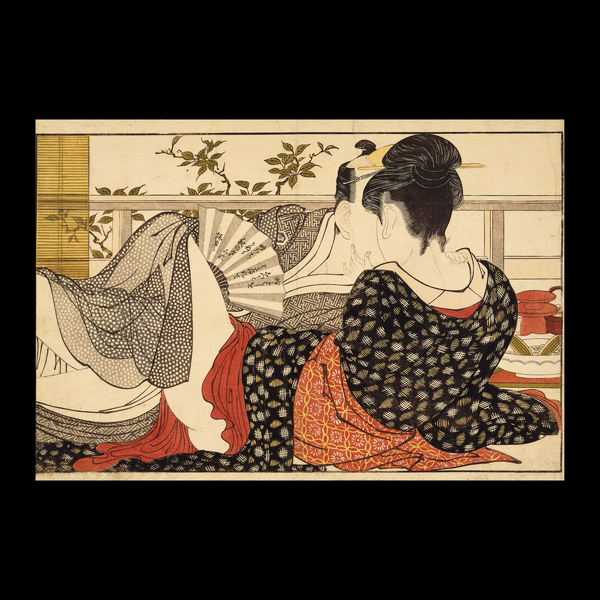
Kitagawa Utamaro :: Lovers in an upstairs room :: 1788
“February 27th
Just as I imagined. My wife keeps a diary. To this day I took the precaution of not writing it in this notebook, but actually my attention was vaguely grabbed a few days ago.
… I am not so vile as to read the diary of my own wife without her permission. However, driven by bad feelings, I tried to cunningly remove the tape that sealed it so as to leave no marks. I wanted to show my wife that a tape alone would be useless.
…
March 7th…
Then I found the key lying in the same place. I thought there must be some reason, and then I opened the drawer and pulled out my husband’s diary. To my surprise, it was sealed with a tape in the same way as I had done. Would my husband want to tell me “Try opening it”?
… I was tempted to try to pull the tape without leaving marks. And so I did it, simply out of curiosity”
Jun’Ichiro Tanizaki is one of the most respected names in the Japanese literature.
Until his death (in 1965, at the age of 79), Tanizaki had never traveled to the West; although in his youth he had flirted with Western modernity, he was never influenced by Christian values or morality.
These choices were instrumental in the structuring of his fictional universe. A member of Tanbiha, a literary school that sought the appreciation of art and beauty (as opposed to the dominant naturalism and objectivism at that time), Tanizaki grounded all of his work in traditional Japanese culture, exploring issues related to eroticism, desire and intimacy, both physical and emotional, which are inherent to affective relationships.
‘The key’, originally published in 1956, tells the story of the sexual life of a middle-aged couple by means of fragments of the diaries where both husband and wife write in secret. At one point in the narrative, however, both begin to suspect that their diaries are being read by the other. Without knowing whether every confession is real or is being forged only for the other to read, characters and reader enter into a subtle and fascinating game that combines eroticism, desire, hypocrisy and ambiguity.
It comprises a little more than 100 pages of exquisite literature. Stripped from the notion of sin – Western and Christian – Tanizaki explores difficult and sensitive issues such as infidelity, (dis)satisfaction, voyeurism and self-destruction, non-judgmentally and elegantly. They are dialogues and situations of apparent simplicity, but that trigger senses and a deep questioning on the limits of desire and pleasure.
‘The Key’ was published in USA by Charles E Tuttle Company. By the same author, I also recommend ‘Quicksand’ (Vintage Books USA) and ‘Diary of a Mad Old Man’ (Random House Trade).
[:]