[:pt]Forma e pensamento[:en]Form and thought [:]
[:pt]
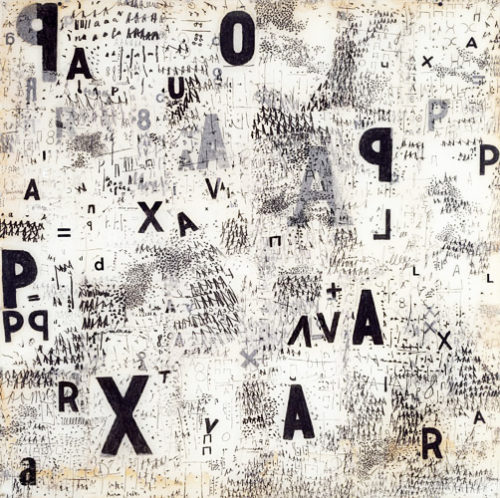
Mira Schendel :: sem título (da série Objetos Gráficos) :: 1967 :: ©moma.org
Dentre os artistas europeus que imigraram para o Brasil durante ou logo após a II Guerra Mundial, e que tanto contribuíram para o enriquecimento da linguagem das nossas artes visuais, Mira Schendel é sem dúvida o nome de maior importância.
Nascida em Zurique, viveu também em Berlim, Milão, Sarajevo, Zagreb e em Roma, até imigrar para o Brasil em 1949, instalando-se em Porto Alegre. Não há registros de qualquer produção artística sua durante a vida europeia; deduz-se que, ao imigrar, ela tenha interrompido a formação universitária em filosofia iniciada na Itália, e começado sua produção artística aqui, como autodidata. Como explicou Geraldo de Souza Dias em 2001, no prefácio do catálogo da exposição da artista no Jeu de Paume, de Paris, ‘sua infraestrutura intelectual, alimentada por inquietudes filosóficas e religiosas, encontrou aqui um ambiente cultural muito mais propício ao estímulo da criatividade artística do que ao rigor científico do pensamento filosófico’.
Os escritos de Schendel são fundamentais para o entendimento da singularidade de sua obra. Sem se ocupar da história da arte, ela se referenciava na psicologia, na ciência, no conhecimento, na teologia e na filosofia para produzir seus trabalhos, sempre balisados por seus próprios pensamentos e princípios estéticos. Predominante na filosofia ocidental pós Platão, a ideia da cisão inerente à natureza humana – corpo vs. alma, matéria vs. espírito – é central em sua obra, muitas vezes permeada por indagações existenciais ou expressões de origem religiosa.
Das naturezas mortas do início, Mira Schendel rapidamente evoluiu para o abstracionismo e em seguida para os escritos – caligrafias de imensa beleza por meio das quais registrava seus pensamentos e inquietudes. Sem abandonar a palavra como expressão do pensamento, Mira foi depois incorporando a esses escritos as letras autocolantes (Letraset©), apropriando-se assim desses signos não apenas como veículos do significado, mas como elementos gráficos de inúmeras possibilidades plásticas. As experimentações com transparências, que permitem que o espectador contemple as duas faces das monotipias, são exemplos máximos da profundidade e da sensibilidade presentes nessa sua investigação.
Não há como não se apaixonar pelos trabalhos de Mira Schendel, nem como deixar de reconhecer seu imenso legado artístico. Ninguém transmutou palavra em arte com tanta elegância, delicadeza e personalidade como ela. Mesmo artistas excepcionais como Léon Ferrari (que dividiu com Mira a grande retrospectiva ‘Tangled Alphabets’ no MoMA em 2009) ou Marcel Broodthaers, todos seus contemporâneos, não conseguiram unir com tal beleza forma E pensamento (corpo E alma, matéria E espírito) – e assim proporcionar a um só tempo, por meio da contemplação de uma obra, reflexões profundas e prazeres tão infinitos.
Para saber mais:
‘Mira Schendel’, catálogo da exposição homônima, Galerie Nationale du Jeu de Paume, Paris, 2001
‘Tangled Alphabets • Léon Ferrari and Mira Schendel’, Luis Péres-Oramas, MoMA & CosacNaif, 2009
[:en]
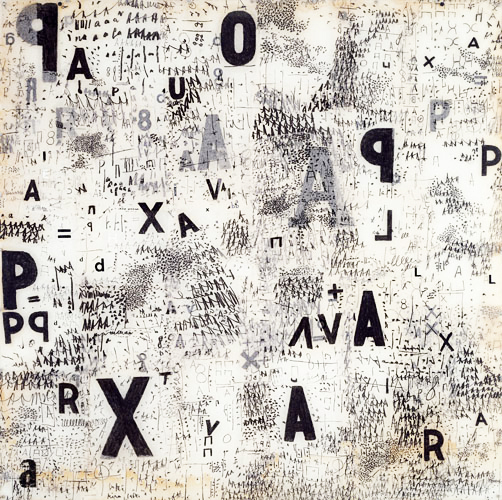
Mira Schendel :: untitled, from the series Graphic Objects :: 1967
From all the European artists who immigrated to Brazil during or shortly after the Second World War and who contributed significantly to the enrichment of our visual arts, Mira Schendel is undoubtedly the name of greater importance.
Born in Zurich, she also lived in Berlin, Milan, Sarajevo, Zagreb and Rome before immigrating to Brazil in 1949, settling in Porto Alegre. There are no records of any European artwork by her; she is said to have interrupted her philosophy degree in Italy and started her artistic production here in Brazil, as an autodidact.
As explained by Geraldo de Souza Dias in 2001 in the preface of her exhibition catalog at Jeu de Paume in Paris, “her intellectual infrastructure, fed by religious and philosophical questionings, found here a cultural environment which was more favorable to the encouragement of artistic creativity than to the strict scientific nature of philosophical thought.”
Schendel’s writings are essential to understanding the uniqueness of her work. Without engaging in art history, she resorted to psychology, science, knowledge, theology and philosophy to produce her work, always based on her own thoughts and aesthetic principles. Predominant in post-Plato Western philosophy, the idea of splitting, which is inherent to human nature – body versus soul, matter versus spirit –, is central to her work, often permeated with existential questionings or expressions of religious origin.
Mira Schendel quickly evolved from still life forms to abstractionism and then to writings – calligraphy of immense beauty through which she recorded her thoughts and questionings. Without abandoning the word as an expression of thought, Mira later incorporated self-adhesive letters (Letraset) into such writings, not only as vehicles of meaning but as graphical elements of countless artistic possibilities. Experiences with transparencies, which allow the spectator to contemplate the two faces of monotypes, are ultimate displays of the depth and sensitivity found in her quest.
One can’t help recognizing and falling in love with the artwork of Mira Schendel.
No one has ever transmuted the word into art with such elegance, delicacy and personality as she did. Even exceptional artists like Leon Ferrari (who shared with Mira the great retrospective ‘Tangled Alphabets’ at MoMA in 2009) and Marcel Broodthaers failed to unite, with such beauty, form and thought – body and soul, matter and spirit – and thus provide, through the contemplation of a work, deep thoughts combined with infinite pleasures.
To learn more:
‘Mira Schendel’, homonymous exhibition catalog, Galerie Nationale du Jeu de Paume, Paris, 2001
‘Tangled Alphabets – Leon Ferrari and Mira Schendel’, Luis Peres-Oramas, MoMA & CosacNaif, 2009
[:]